
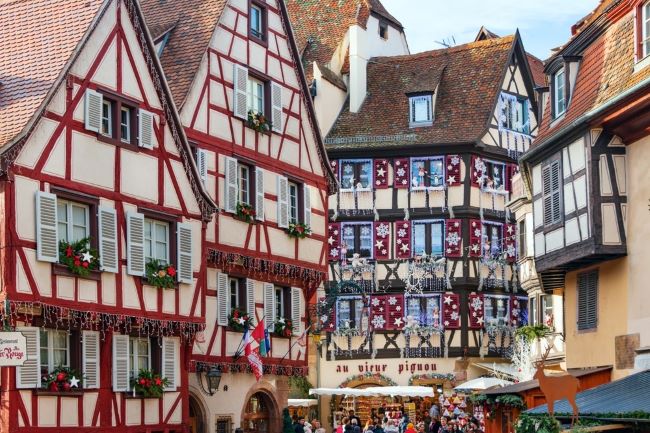
Old-European style Christmas markets in cities that line the Rhine and Danube are well known. River cruise lines offer lovely trips down rivers with stops in Budapest, Vienna, Prague, and other places that are decorated for the holidays. We, however, suggest a lesser known, even more charming, and land-based destination. Alsace.
A December trip through Colmar, Strasbourg, and Riquewihr is one of Europe’s most enchanting winter experiences.
The food is fragrant, the crafts are beautiful, the markets are old-world treasures—and the memories linger long after the final candle has been extinguished for the season.
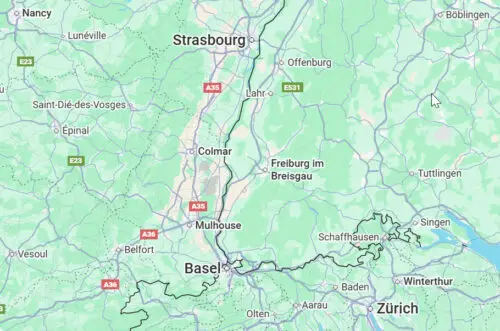
Make Colmar your home base, situated between the other two towns. That way you can enjoy the best of all worlds: dazzling Christmas grandeur in Strasbourg, medieval charm in Riquewihr, and the everyday magic of Colmar’s softly lit streets.
Colmar: Five Christmas Markets in a Walkable Wonderland
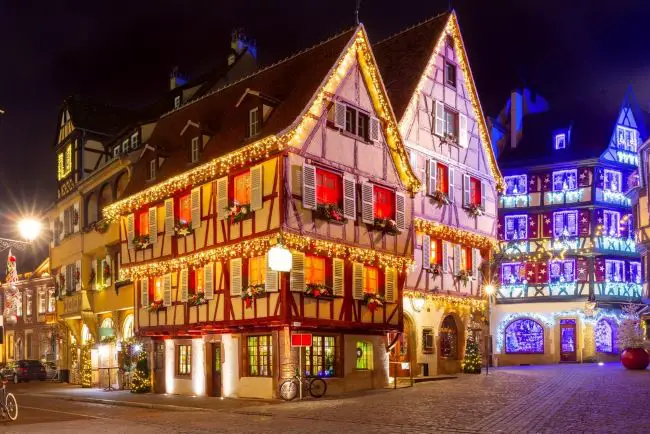
Colmar is often dubbed “Little Venice” because of its scenic canals and picturesque half-timbered houses. In December, Colmar transforms into a storybook holiday town.
Colmar is a delight at any time of year, but in December it becomes a snow-globe village lit with garlands and shimmering storefronts. Its location between Strasbourg and Riquewihr makes it the perfect base to experience the delightful towns of Alsace.
Six, yes six, Christmas markets
Colmar’s historic center is easy to navigate even for those who prefer gentle strolling. The town hosts six distinct Christmas markets, each with its own personality. They sit within a five-minute walk of one another, meaning you can wander from one to the next in a leisurely loop, pausing for warm treats along the way.
Expect charming wooden chalets around the historic squares: stalls of handmade crafts, regional delicacies, festive decorations, and warm pastries. Local specialties such as Alsatian gingerbread, mulled wine, and seasonal treats mingle with artisan crafts and gifts. Try the Kougelhopf (the region’s signature brioche cake, dusted with sugar) or a warm Tarte flambée, fresh from a wood oven. At the stalls you’ll find charming Alsatian pottery from nearby Soufflenheim and Betschdorf, as well as stork-themed ceramics (the stork is the symbol of Alsace).
The Musée Unterlinden is a major regional museum housed in a former convent, It is best known for the Isenheim Altarpiece and collections that trace religious and artistic history in the Upper Rhine. It’s an excellent counterbalance to the markets and street life.
Beyond the Christmas markets
La Petite Venise (Little Venice) is a compact canal district lined with colorful half-timbered houses. At night, the canals reflect the lights of decorated facades, one of the most photographed sights in Alsace. The soft glow of streetlamps makes everything feel like an illustration in a holiday storybook. Staying here means you can enjoy these quiet moments long after the day-trippers have gone.
Strasbourg: The Heart of European Christmas
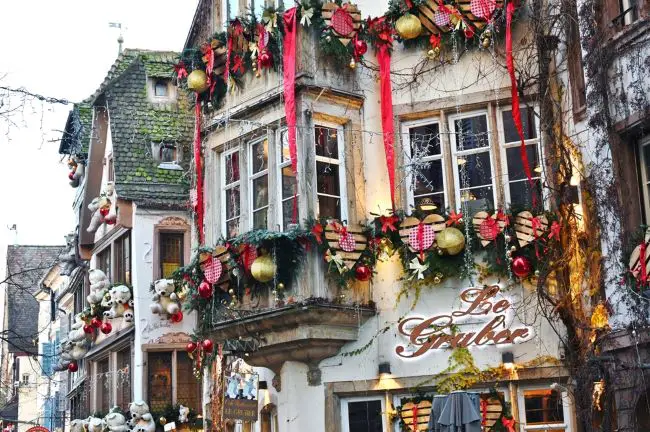
Christmas market aficionados, especially if they’re French, consider Strasbourg the “Capital of Christmas.” As December unfolds, the historic center, the UNESCO-listed Grande Île, becomes a winter wonderland: narrow cobblestone lanes glow under twinkling lights, shop windows shimmer, and the air smells of mulled wine, gingerbread, and roasted almonds.
One of the oldest markets in Europe
The Christkindelsmärik — the city’s main Christmas market — dates back to 1570 and remains one of the oldest and most celebrated holiday markets in Europe. In the heart of Place Kléber, the “Grand Sapin,” towers 31 meters (103 feet) above the square. To put that into perspective, the Christmas tree at Rockefeller Center is 75 feet tall.
Walking beneath the spires of the Gothic cathedral, you’ll pass stalls overflowing with handcrafted ornaments, wooden toys, delicate pastries, and regional treats. On cold evenings, wrap yourself in a warm, snuggly scarf and stroll around — the atmosphere is quietly magical.
Strasbourg markets also offer Alsatian specialties. Try Bredele, small Christmas cookies in buttery, almond-spiced, aniseed, and cinnamon varieties. Many stalls will be filled with Pain d’épices (gingerbread), often spiced with honey, cinnamon, nutmeg, and cut into festive shapes.
There’s more to see beyond the markets. Cathédrale Notre-Dame de Strasbourg is a towering Gothic cathedral with remarkable stained glass and an intricate façade. The viewing platform offers a superb panorama over the Grande Île and Christmas lights. The interior also has an astronomical clock that is a highlight for many visitors.
The half-timbered riverside quarter of La Petite France, with its canals and medieval houses, is the most atmospheric area for wandering, and the nearby Ponts Couverts and Barrage Vauban terrace give classic postcard views back over the quarter and cathedral.
Avoid arriving by car. The center becomes car-free for the duration of the market season. Instead, park in one of the “P + R” lots and take the city’s excellent public transport or shuttle into town.
Riquewihr: A Medieval Village Frozen in Time
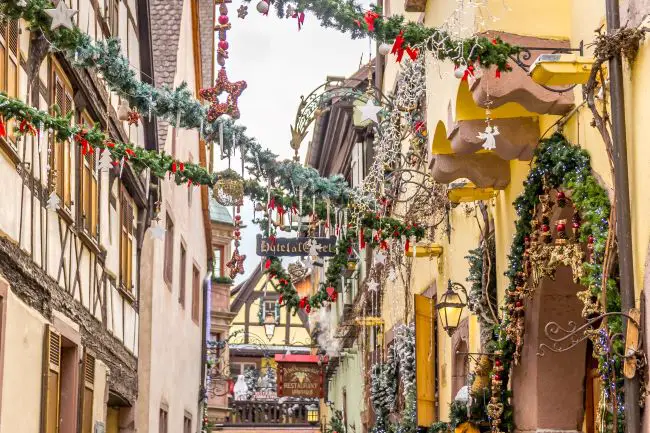
Riquewihr is one of France’s most beautiful villages, nestled among vineyards at the foot of the Vosges Mountains. In December, the village becomes a living postcard.
The Riquewihr Christmas Market runs roughly from late November through December. It is set around the fir tree on the Place Fernand Zeyer, under the trees of the Esplanade des Remparts, among cobbled streets and half-timbered facades.
Unlike in larger cities, Riquewihr’s market feels intimate and peaceful — perfect for a slow morning stroll with fewer crowds. Browse handcrafted goods, regional wines, local delicacies, and small souvenirs. Macarons d’Alsace are chewy, almondy, and rustic (not the Parisian kind). Tourte vigneronne is a winemaker’s pie made with Riesling.
Local wines, including Riesling, Gewurztraminer, and the region’s beloved Crémant d’Alsace, are available for tasting. Many wine experts call Riesling the king of wines, so this visit gives you a chance to experience some of the best.
Walking a short stretch of the village ramparts near the upper gate lets you look back over Riquewihr’s roofs and straight out to the surrounding vineyards, giving a strong sense of the village’s medieval scale and winegrowing landscape.
As twilight falls, the lights come on: the old tower (the “Dolder”) glows softly, casting warm light on ancient walls. Then, settle in for a hearty Alsatian meal in a cozy tavern — perhaps some tarte flambée, choucroute or other regional specialties.
The combination of vineyards, medieval houses, quiet cobblestone streets, and friendly village-scale markets gives Riquewihr a more serene, magical experience compared with the bustle of big-city markets. A visit to a village like this feels like stepping into a Christmas postcard.
* * *
You may also like
- Chartres, Amiens, Reims: Three unforgettable day trips from Paris
- Where in the world is the best hot chocolate?
- Mary’s Coq au Vin belongs on your table
Find more articles for women over 60 on Blue Hare’s home page.